
AI Video Weekly Roundup — March 6, 2026
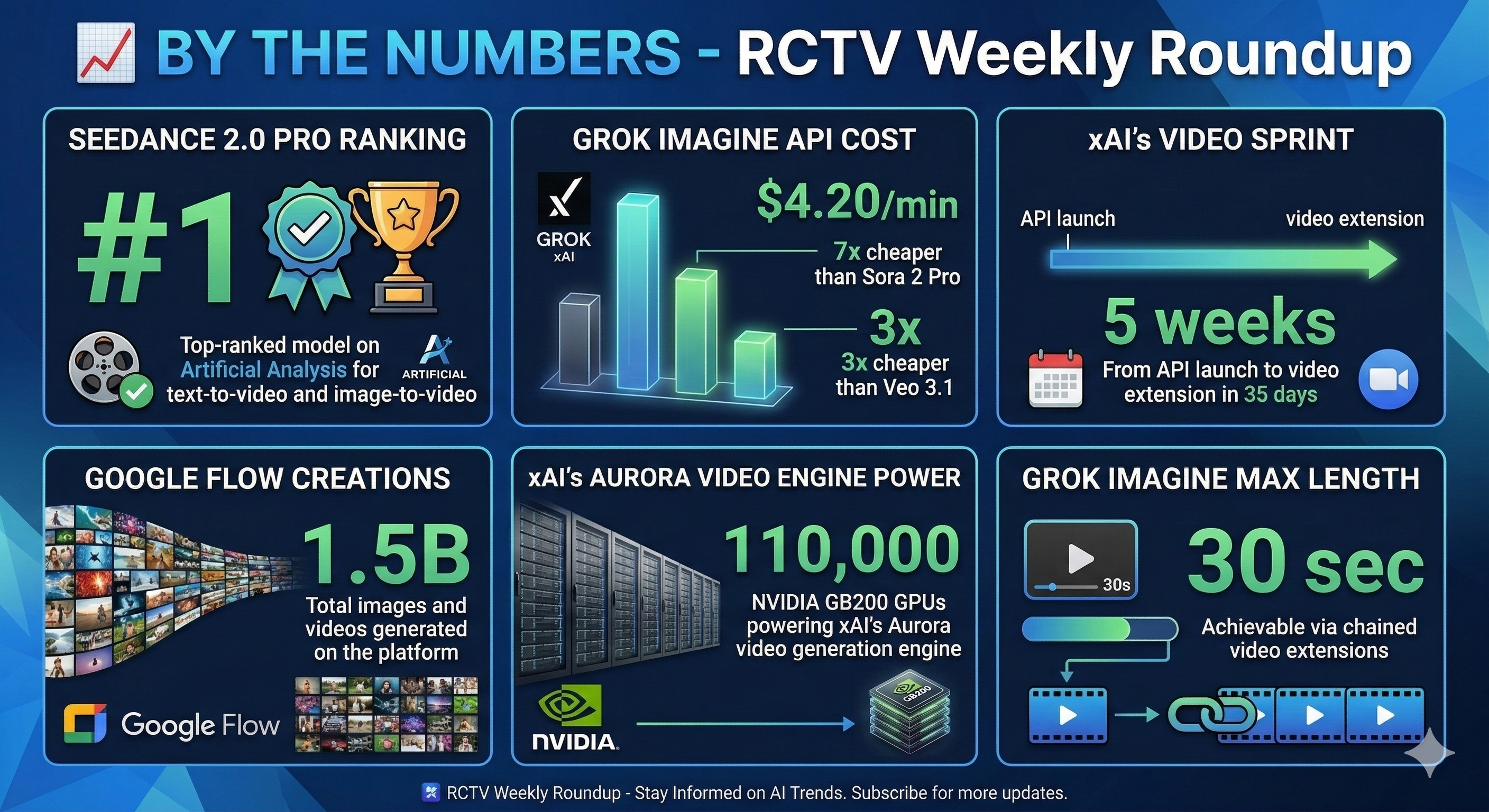
This was the week AI video stopped being a China-vs-US model race and became a platform war. Three major ecosystem moves — Grok Imagine’s video extension, Google Flow’s consolidation, and Seedance 2.0 Pro’s third-party breakout — all signal the same shift: the generator is becoming a commodity. The workflow around it is the product.
Models covered: Seedance 2.0 · Regulation
🎬 Seedance 2.0 Pro Goes Global — Through the Back Door
ByteDance’s Seedance 2.0 Pro is now accessible to international creators, but not through ByteDance. Third-party platforms like BigMotion and LumeFlow AI launched integrated access this week, bypassing the official global rollout that ByteDance indefinitely paused in late February after Hollywood’s legal barrage.
The model itself is formidable. Seedance 2.0 Pro ranks first in both text-to-video and image-to-video on Artificial Analysis, ahead of Veo 3, Sora, and Kling 2.0. It generates cinematic video up to 2K resolution with native audio, multi-shot sequencing, and frame-level consistency — all from a Dual-Branch Diffusion Transformer architecture that produces audio and video in a single pass.
BigMotion is charging $35–$95/month for access. LumeFlow bundled it alongside Kling 3.0, Sora 2, and Veo 3.1 in a single dashboard with motion mimic and lip-sync tools.
Meanwhile, ByteDance’s own global API remains frozen. The Motion Picture Association and studios including Disney, Netflix, and Paramount issued cease-and-desist letters after viral deepfakes featuring celebrity likenesses. ByteDance also suspended its “Face-to-Voice” feature on February 10 after it was shown to clone voices from a single photo. Japan has opened its own inquiry after unauthorized anime character reproductions surfaced.
Why it matters: The best AI video model in the world is now available globally — just not from its maker. This fragmented access pattern, where third parties ship what the original developer can’t due to regulatory pressure, is likely to become the norm for cutting-edge Chinese AI models entering Western markets.
🔧 Grok Imagine Gets Video Extension — xAI’s Five-Week Sprint
xAI shipped video extension for Grok Imagine on March 2, letting users chain generated clips by continuing from the final frame. The feature preserves lighting, motion, and character positioning across extensions, enabling sequences up to 30 seconds.
The pace of xAI’s iteration tells the real story. From API launch on January 28 to Grok Imagine 1.0 on February 3 to video extension on March 2 — that’s four meaningful updates in five weeks. The Aurora engine running on 110,000 NVIDIA GB200 GPUs gives xAI compute that few competitors can match.
There are real limitations. Resolution caps at 720p — every major competitor except Seedance 1.5 Pro offers 1080p. Community testing confirms visible quality degradation after two or three chained extensions. And all video features remain locked behind X Premium subscriptions.
On the plus side, Grok’s API pricing undercuts the field dramatically: $4.20 per generated minute versus Sora 2 Pro at $30 and Veo 3.1 at $12. For social media content where 720p is acceptable, the economics are compelling.
Why it matters: xAI is building the fastest-iterating video generation pipeline in the industry. The 720p ceiling and quality degradation on chained extensions are real constraints, but the speed of improvement suggests these won’t last long. Grok’s 500 million X users represent a distribution advantage no other video model has.
🔄 Google Flow Absorbs Whisk and ImageFX — The Platform Play
Google’s March redesign of Flow is now live, merging three previously separate tools into a single creative workspace. Whisk (visual mood boards and style transfer), ImageFX (text-to-image generation), and Flow’s video generation now share one interface.
The practical impact: you can build a mood board in Whisk with reference images, apply that style to image generation via ImageFX, then animate the result into video — all without leaving the workspace. Multi-clip sequencing with automatic transitions, character consistency across scenes, and ImageFX keyframe injection for guided generation are all now available in the unified tool.
Google reports Flow users have created over 1.5 billion images and videos since launch. Whisk and ImageFX project migration is available starting this month.
YouTube integration is widely expected before year-end. Google will not keep its best video tool separate from its biggest video platform forever. Paid tiers will likely follow the Veo 3 API model with per-second charges once the free beta builds critical mass.
Why it matters: Google is making the clearest bet in the industry that the future of AI video is integrated workflows, not standalone generators. Flow is becoming the closest thing to an AI-native creative suite — and it’s free. If YouTube publishing lands, the distribution moat becomes enormous.
⚖️ Hollywood’s Copyright Crackdown Reshapes the AI Video Map
The Seedance situation crystallized a broader trend this week: Hollywood is now actively shaping which AI video tools reach global markets and in what form.
The MPA’s cease-and-desist letters to ByteDance cited “systemic copyright infringement” — specifically, the model’s ability to reproduce recognizable fictional characters and scenes from copyrighted films at scale. SAG-AFTRA weighed in separately over celebrity likeness deepfakes. ByteDance’s response has been to pause the global rollout, suspend the Face-to-Voice feature, and add identity verification for avatar creation.
This isn’t just a Seedance problem. Grok Imagine faced its own regulatory scrutiny earlier this year when its “Spicy mode” enabled explicit content generation using real people’s likenesses, triggering investigations from the UK’s Information Commissioner’s Office, France’s cybercrime unit, and California’s Attorney General.
The emerging pattern: models launch with minimal guardrails, viral misuse generates legal and regulatory pressure, and the maker retrofits safety features under duress. ByteDance calls this period a “safety audit.” Critics call it “violate first, patch later.”
Why it matters: Copyright enforcement is becoming a de facto market access barrier for AI video models. Studios and talent guilds have found that legal pressure works faster than legislation. Every AI video company now has to factor Hollywood’s tolerance into their launch strategy — not just technical readiness.
📈 By the Numbers
- #1 — Seedance 2.0 Pro’s ranking on Artificial Analysis for both text-to-video and image-to-video, ahead of Veo 3, Sora, and Kling
- $4.20/min — Grok Imagine’s API video generation cost, versus $30/min for Sora 2 Pro and $12/min for Veo 3.1
- 5 weeks — Time from Grok Imagine API launch to video extension shipping (Jan 28 → Mar 2)
- 1.5B — Images and videos created by Google Flow users since launch
- 110,000 — NVIDIA GB200 GPUs powering xAI’s Aurora video engine
- 30 sec — Maximum video length achievable via Grok Imagine’s new extension chaining
🔮 What to Watch Next Week
- Seedance 2.0 Pro hands-on reviews from creators accessing it through BigMotion and LumeFlow — expect the first serious production tests from Western creators
- NVIDIA GTC 2026 is coming later this month — watch for next-gen local AI video generation announcements
- Google Flow’s YouTube integration timeline — any hints from Google’s developer channels would be a major signal
RCTV’s AI Video Weekly Roundup is published every Friday. Subscribe to stay ahead of the curve.
For full specs, pricing, and access details on every model covered this week, see the AI Video Generation Tools 2026 reference page — updated every Friday.